Showing posts with label japan. Show all posts

Saturday, May 28, 2011

Pint-sized underdog exceeds all expectations, and gets the girl

Helen Smith (adaptation)
Junko Morimoto (illustrations)
The Inch Boy
Puffin, 1984

After an old couple ask the Buddha for a child, they discover a one-inch-long baby crying outside their home. They name him Issonboshi for his diminutive figure, but his ambitions are super-sized. Seeking to become a samurai to the Lord Sanjo, Issonboshi proves his mettle when facing down the red demon threatening Sanjo's daughter, Makiko. Predictable in plot and stereotype, The Inch Boy is nevertheless charming.

Thursday, May 26, 2011

How the Darumas earned their eyes

Winifred E. Wise (author)
Beverly Komoda (illustrator)
The Revolt of the Darumas
Parents' Magazine, 1970

  Kojima and his sisters have three roly-polys, or Darumas, which they call Big D. Middle D. and Little D. Following tradition, they draw in only one eye on each Daruma, promising that if the roly-polys grant their wishes, then they will draw in the other eye. The obedient children go out to play, and that is when the malicious Tengu with the big nose goes to work making mischief. When the children return, an uneasy scene awaits. Who made a hole in the paper door? Why is the Tengu mask on the floor? Where have the roly-polys disappeared to? But as the Darumas go to work making magic, disappointment gives way to happiness and generosity among the good, while the wicked only brings harm to himself. Winifried E. Wise's story, published in 1970, is well worth revisiting. The humorous charm of roly-poly beings is timeless. Those of you have seen them croaking and hopping about the queen's castle in Murasaki's Spirited Away know this. And, like Spirited Away, The Revolt of the Darumas has moments of transcendency, as when the roly-polys spend the night in the pond turning and drifting, sometimes able to see the fish through their one eye, other times seeing the stars. I would like to see a publisher step forward to update the content and prose, giving for example, names to the sisters. A new title, too, could highlight the resolution in the Darumas' action.
  I would also like to say a big thank you to a dear friend who has sent me this and several other children's books for this blog.
  Finally, can anyone speak to the accuracy of the practice of making wishes and drawing in Darumas' eyes?

Sunday, May 15, 2011

Wake me when my dream comes true


Dianne Snyder (author)
Allen Say (illustrator)
The Boy of the Three-Year Nap
Houghton Mifflin, 1988
  Set in pre-modern Japan, Dianne Snyder’s story of Taro and his widowed mother reminds us that even the most cunning of children may nevertheless be outwitted by their more experienced mothers. Taro’s laziness has earned him the nickname, “The Boy of the Three-Year Nap.” At the end of her patience and her resources, his mother urges Taro to work for the merchant. But slothful Taro would rather undertake a life of leisure and toward that end he masquerades as the ujigama, the town’s god, to take advantage of the merchant. Frightened, the merchant obeys the ujigama’s order to marry his daughter to Taro. But when he comes to ask the widow’s consent, she finds a way to cure Taro of his laziness.
  In their style, clarity, and narrative humor, Allen Say’s illustrations remind one of Hokusai’s woodblock prints.

Thursday, May 5, 2011

A family trilogy

Allen Say
Tree of Cranes (Houghton Mifflin, 1991)
Grandfather's Journey (Houghton Mifflin, 1993)
Tea with Milk (Houghton Mifflin, 1999)


Some of us are set fast-forward to the future. Others of us wonder about the past. Where did our parents and grandparents come from, we ask. And we use the answers to understand who we are and where we are going. Allen Say shares his family's story in three beautifully illustrated and and somewhat wistful books.
  In Tree of Cranes, Say is a young boy in Japan. His mother, who grew up in the United States, celebrates his return to good health and commemorates her own childhood with a hybrid Christmas tree.
  Grandfather's Journey memorializes the life of Say's grandfather, who may seem acculturated and settled with his family in California, returns to Japan.
  Tea with Milk concerns Say's mother, who is wrenched from the comforts of California when her father brings the family back to Japan. She eventually meets a fellow with unconventional tastes that match her own.
  All of the books speak thoughtfully and gently about the un-ease of being caught between cultures, an increasingly common experience in our post-modern, globally connected world. Say's family seems to have pioneered this path, and he is generous to share its intimacies and beauty with us.

Tuesday, April 26, 2011

Love Seen and Lost

Sumiko Yagawa (retelling)
Katherine Paterson (translation)
Kuekichi Akaba (illustrations)
The Crane Wife
William Morrow, 1981

Yohei, the Japanese everyman who was last encountered in this blog as a the son of a fishmonger, is in The Crane Wife a poor peasant in a mountain village. After he helps a wounded crane, a beautiful young woman knocks on his door and asks to become his wife. As the couple struggles to make it through the cold winter, she offers to weave cloth to sell in the market on the condition that Yohei refrain from watching her at the loom. Inevitably, predictably, and tragically he cannot restrain himself. In the end, Yohei is left with a bolt of gorgeous, unearthly cloth and no wife. Enthusiasts of Greek myths may hear in this Japanese folktale echoes of Psyche and Cupid. Kuekichi Akaba's illustrations are like the crane wife herself, delicate and enchanting and elusive. Beside her eloquent English rendering, Katherine Paterson gives us a note about the understandable popularity of the crane wife story in Japanese culture.

Monday, April 25, 2011

Kitchen Maid and One-eyed Steward Live Happily Ever After

Katherine Paterson (author)
Leo and Diane Dillon
The Tale of the Mandarin Ducks
Lodestar, 1990

The gorgeous plumage of a male mandarin duck captures the attention of a Japanese lord who delights in the possession of beautiful things. The lord's one-eyed retainer, Shozo, however, sees more deeply. Shozo knows that the drake will languish and die in captivity, but his compassionate advice to let the bird go earns only the lord's scorn. Katherine Paterson crafts a classic tale pitting power and vanity against against charity. Inspired by Japanese woodblock prints, Leo and Diane Dillon's eye-catching illustrations lure us into this tale about sight and insight.

Friday, April 22, 2011

Peach-boy, superhero

Stephanie Wada (retelling)
Kano Naganobu (paintings)
Momotarō and the Island of Ogres
George Braziller, 2005

Since East Asian painting has long interested me, I was delighted to find this illustrated folktale. Stephanie Wada, a curator of Japanese art, illustrates her retelling of Momotarō with details taken from a set of two handscroll paintings by Kano Naganobu (1775-1828), a painter to the Tokugawa shogunate. The wide, skinny format of the book shows parts of the painting to their best advantage. As we follow the adopted Momotarō, born from a peach, along his journey to Onigashima (the island of ogres), we are treated to splendid landscapes of rivers and mountains, scenes of confrontation and battle, and views of triumph and celebration. The images are subtler than your run-of-the-mill picture book, and the prose more adult. Together, images and text demand and reward more careful engagement. If only we could have kibi-dango dumplings as part of our reward, too!

Thursday, April 21, 2011

Follow that cat

Koko Nishizuka (author)
Rosanne Litzinger (illustrator)
The Beckoning Cat: Based on a Japanese Folktale
Holiday House, 2009

You know the one. The one that sits at restaurants and supermarkets and gift shops starting wide-eyed and raising a single paw at you. That's the one. They are everywhere, and apparently it all started with Yohei, a Japanese "everyboy." Yohei is a fishmonger who sells his fresh catch door-to-door. But when father falls ill, he must forego his work and meager earnings to look after his father at home. Despite the family's poverty, Yohei always shared some fish with a white cat, who now returns his generosity by beckoning customers to his home. Story and pictures are cute, and it's generally nice to reinforce the belief that goodness is rewarded, but there is not much more than that. I'm glad to have an explanation of the beckoning kitties, but now I'm left wondering, why do blue morning glories appear throughout the story?

Monday, April 11, 2011

binga-binga

Katherine Paterson (translator)
Momoko Issii (author)
Suekichi Akaba (illustrator)
The Tongue-cut Sparrow
Lonestar Books, E. F. Dutton, 1987

Binga-binga, or sparkling clean, is how the old man renders first an ox and then a horse as he seeks the home of the tongue-cut sparrow. After performing these menial tasks with care, he meets the sparrow and offers an apology for his wife's cruelty (she was the one who snipped its tongue). In return, the sparrow offers the man a fine meal and the choice of two baskets, large or small, to take home. But...he must not open the basket until he reaches home. Heeding the sparrow's caution, he returns home where he and his wife are astonished by the treasure inside the basket. The thought of more treasure fills the old woman with greed. Thus, she makes her own trek to the home of the tongue-cut sparrow, leaving in her wake, gosho-gosho, a poorly washed ox and a poorly washed horse. Although we all know she will get her just desserts, it is still great fun to read about it. A series of onomatopoetic Japanese terms gives our own tongues some fun, and the caricatured expressions in Suekichi Akaba's spare illustrations are cute, monstrous, and funny. Words and images work together to stamp this folktale and its moral into our memory.

Saturday, March 12, 2011

Giant Rice Cake Is Couple's Reward

Ann Tompert (author)
Demi (illustrator)
Bamboo Hats and a Rice Cake: a tale adapted from Japanese folklore
Crown, 1993

An old couple wish to have traditional rice cakes for the New Year, but they are very poor. Husband and wife agree to trade her 着物 (kimono) for 餅 (rice cakes). On his way to the market, the old man stops to brush the snow off six Jizo statues, promising to share 餅 on his return. Even before reaching the market, the old man begins to barter. First, the 着物 for some 扇 (fans), then 扇 for a gold 鈴 (bell), and so on until he leaves the market with five 笠 (bamboo hats). Along with his own, the old man gives the hats to the six Jizo before he returns home empty handed. His wife is not disappointed, but proud of her husband's kindness, and their virtues are rewarded. Ann Tompert's adaptation is moving, and incorporates kanji like rebuses. She carefully selects the characters so as to introduce readers to another language while reinforcing the narrative flow. Demi's illustrations are consistently delicate, sensitive, and alluring.

Tuesday, February 22, 2011

Sushi chef's story

Lynne Barasch
Hiromi's Hands
Lee & Low, 2007

Lynne Barasch tells the true story of Hiromi Suzuki (a chef in a Japanese restaurant in New York City), who learns from her father how to select fish, scrub floors, prepare rice, and roll outstanding sushi. Along the way, Barasch compares the patriarchal norms of the traditional Japanese society in which Hiromi's parents, Akira and Kaoru grew up, to the possibilities that characterize the more contemporary America to which they immigrated. At times, Barasch tells more than she shows, but the story can inspire girls to challenge norms that would exclude them. The book closes with an illustrated dictionary of select sushi, a photograph of the real Hiromi, and a glossary with pronunciation.

Sunday, February 20, 2011

Key to happiness

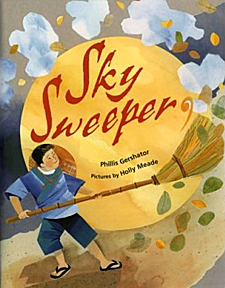
Phillis Gershator (author)
Holly Meade (illustrator)
Sky Sweeper
Farrar, Straus, and Giroux, 2007

Takeboki is the Flower Keeper at a Japanese Buddhist temple. From youth to old age, throughout the seasons, he joyfully cares for the garden. Holly Meade's pictures are enchanting, the next best thing to being in a garden oneself. Phillis Gershator's tale is gentle, and interestingly open to interpretation. Sometimes, I wonder if Takeboki's example sends the wrong message, encouraging acceptance of hierarchy and inequality. But other times, I am persuaded that Takeboki makes a profoundly wise choice.

Tuesday, February 1, 2011

Canine companions

 Wendy Tokuda and Richard Hall (authors)
Kern Okasaki Sasaki (illutrator)
Shiro in Love: A True Story
Heian, 1989
Pamela S. Turner (author)
 Yan Nascimbene (illustrator)
Hachiko: The True Story of a Loyal Dog

  Here are two stories of remarkable dogs in Japan. After being rescued from a dump, Shiro began commuting in the mid-1980s from the tropical island of Aka to a neighboring island, Zamami, to visit his doggy sweetie, Marilyn. She must have been irresistible (like her namesake?), for Shiro swam two miles to see her, only later figuring out that he could take the ferry service.
  In the mid-1920s, Hachiko could be found waiting patiently between the morning and evening commutes at Shibuya Station for his master, Dr. Ueno. Even after Dr. Ueno's death in 1925, Hachiko continued to wait, earning him so much admiration that people came to Shibuya just to pet him. Only Hachiko's death brought his vigil to an end. Travelers to Shibuya Station now arrange to meet at "Hachiko," a bronze likeness commemorating this dog's remarkable loyalty. Yan Nascimbene's woodblock print-inspired illustrations alternate delicate and sensitive images of Hachiko with larger pictures of humans and their built environment, underscoring the special relationship between species at the heart of this book.

Sunday, January 23, 2011

Cinderella's sister

Alan Schroeder (author) and Yoriko Ito (illustrator)
Lily and the Wooden Bowl
Doubleday, 1994

This lovely, traditional folktale rewards the virtuous and beautiful Lily with marriage to the noble and handsome Kumaso. Hints of the Cinderella story abound. Upon her death, a loving grandmother grants with three magical objects to protect her Lily: a rice paddle, a paper crane, and a lacquered wooden bowl. The objects come to Lily's rescue as she must defend herself against a venal and jealous mother figure, Matsu, who is not coincidentally Kumaso's mother. Matsu uses sorcery and lies to try to cast Lily from the household, but Kumaso and his father Yamoto both see the truth of Lily's innocence. Alan Schroeder's retelling flows beautifully; Yoriko Ito's illustrations are gentle, dreamlike, and dramatic. Whatever your opinion on the power and value of feminine beauty, and the impact of concealing it, the wooden bowl is an alluring symbol used to narrative and visual advantage here.

Tuesday, December 14, 2010

Stones with your cherries?

Tim Myers (author) and Oki S. Han (illustrator)
Basho and the River Stones
Marshall Cavendish, 2004

I reviewed Tim Myers' Tanuki's Gift on Thanksgiving, and now with Basho and the River Stones I feel gratitude again for his writing. Again, the theme is friendship and the things in life that really matter. Matsuo Basho, Myers' informs us, is one of Japan's most famous poets. While two haiku capture the deep feelings of the book's two characters, Basho and a shape-shifting fox, poems are not the focus. Instead, the book moves from greed (over cherries) to deception to anger and disappointment. Then, with a moment of insight, those emotions dissolve into gratitude and honor on the part of the former victim, and shame and resolve to make amends on the part of the perpetrator. In a world where injustice and inequality are altogether too common, Myers' Basho helps us to remember plenitude and joy and humor, and to act in forthright and compassionate ways. Oki S. Han's illustrations vibrate with color and immerse us, as Basho's river stones, in a world of sensory satisfaction.

Sunday, December 12, 2010

More Japanese kitties

Margaret Hodges (adapted by)
and Aki Sogabe (illustrations)
The Boy Who Drew Cats
Holiday House, 2002

Margaret Hodges' story of Japanese zen monk and artist Sesshū Tōyō (1420-1506) as a boy is charming and suspenseful. In many ways, the young Sesshū is like any other boy, quick but easily distracted. But his obsession with painting cats everywhere—temple columns and walls, and fusuma (sliding doors)—sets him apart. The habit impels the narrative forward and generates the happy ending. Aki Sogabe's illustrations rise to the challenge of depicting one of Japan's most famous artists. They have the thick line and flat colors of modern woodblock prints, which might sound dull, but quite the opposite. The images are fresh, and the expressive cats, which teeter towards madness in their bizarre combination of domestication and wildness, steal the show.

Friday, December 10, 2010

Child makes her world a better place

Mercer Mayer
Shibumi and the Kitemaker
Marshall Cavendish, 1999

Readers with some background in Japanese history and culture will see immediately that Mayer's story of a princess, Shibumi, and her wish for a more equitable and flourishing city is pieced together with his own imagination. The well-crafted story recalls early on the life of the historical Buddha and maintains the quality of a folk-tale. In addition, Mayer's illustrations follow the same pattern, inserting a famous Shinto sculpture here, then drawing freely from Japanese styles of art and architecture elsewhere. Perhaps these aspects explain why I found this book in the folk-tale and not the picture book section of a local, public library. Contradicting historical patterns, Mayer places his emperor in a shogun's castle and gives him a loyal samurai. But the truths of parents' love for their child and of a child's yearning for an ideal world are incontestable.

Thursday, December 2, 2010

Hello kitties

Last time I went to the library, I noticed at least three children's books that featured Japanese cats. I was struck by this high incidence of felines, but then I remembered Hello Kitty, and had a moment of "Duh, of course!" I'll get to all of these books in due time. Cat lovers and Japanophiles, here is the first one.

In Eric A. Kimmel's Three Samurai Cats, a brute of a rat terrorizes a hapless daimyo, or feudal lord, who seeks help from the eponymous three samurai cats. The rat makes short shrift of the first two felines, despite their show of force. The third, rather decrepit-looking cat tests the daimyo's patience with his opaque strategy, but the rat finally succumbs to his gluttonous appetite for glutinous treats. Kimmel's lively prose is nicely matched with Mordicai Gerstein's comic images.


Eric A. Kimmel (author) and Mordicai Gerstein (illustrator)
Three Samurai Cats: A Story from Japan
Holiday House, 2003

Thursday, November 25, 2010

Give thanks

Tim Myers (author) and R.G. Roth (illustrator)
Tanuki's Gift: A Japanese Tale
Marshall Cavendish, 2003

A quiet story with watercolor collages lifts us into another world of modest, but nevertheless fully satisfying surroundings. The friendship between a Buddhist priest and a tanuki, or raccoon-dog, blossoms in the bareness of winter. Roth's exuberant images capture a full-body joy that we readers also share. Tim Myers' retelling reminds us of what is really important in life.

Happy Thanksgiving, dear readers, one and all.

Sunday, November 14, 2010

Years pass swiftly

The story of Momo's birthday gift, an umbrella, is told as a flashback from the gentle and wistful point of view of a parent. Of all her modest gifts, Momo is most enchanted by an umbrella, which she yearns to use. Sunny day after windy day, she tries to persuade her mother to let her use it. Finally, a rainy day comes, and Momo thrills. With her umbrella, she is growing up, conscious of achieving a lady-like posture, but she is also young still, captive to the rhythm and song of raindrops playing on her umbrella. Her parents, too, remember how Momo grew up that day, for she did not need to hold her parents' hands. In Umbrella, Taro Yashima gives us a beautiful essay about how the passage of time—at once swift and slow—is experienced and marked by parents and children. As for the images, think Goodnight Moon with the touch of impressionist Edgar Degas.


Taro Yashima
Umbrella
Viking, 1958